

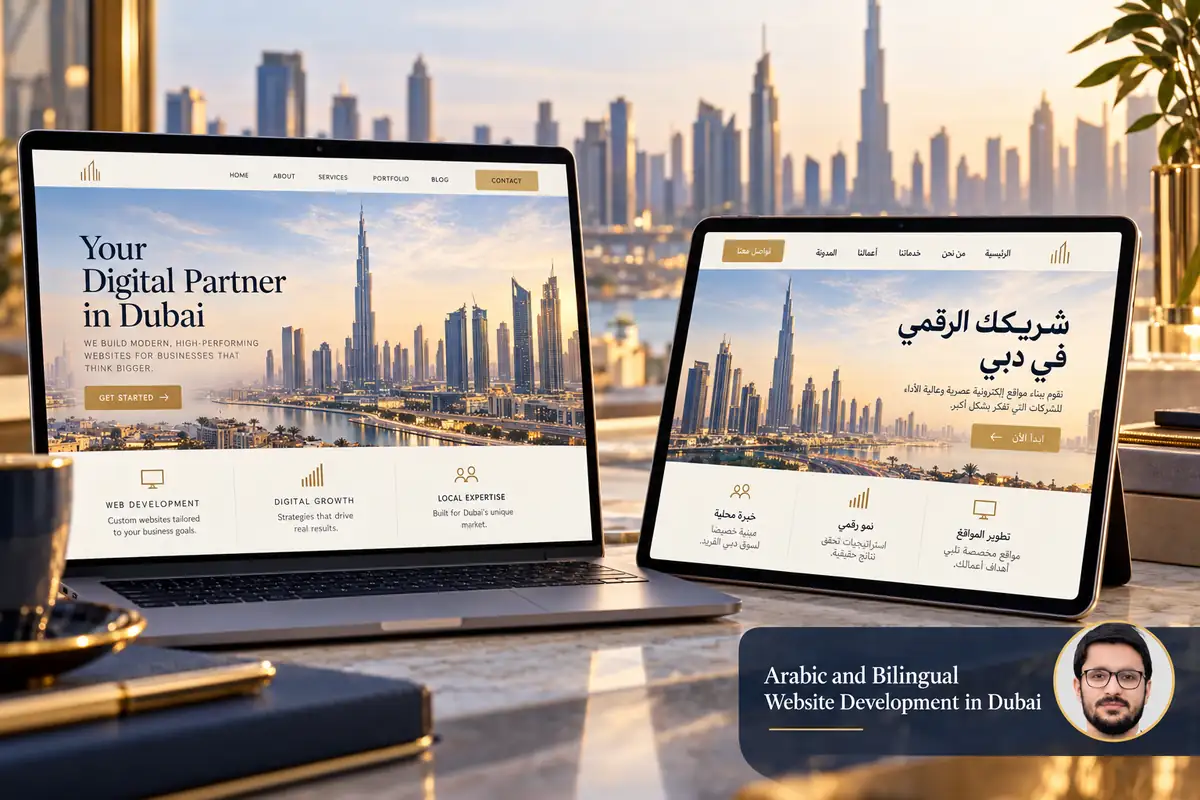
A bilingual website is not simply an English website with a translation switcher. For businesses in Dubai, a good Arabic-and-English experience requires thoughtful writing, right-to-left layouts, navigation, forms and search behavior that feel natural in both languages.
If you are planning Arabic website development in Dubai, these are the decisions worth making before design begins.
Decide which audiences each language will serve
Start by understanding the people who use the site. Some visitors may browse in English but prefer customer support in Arabic. Others may want a complete Arabic purchasing journey. Clarify which pages, products, policies and service information need to exist in both languages.
Avoid assuming the same words, imagery and sales messages will work equally well in every context. Translate the meaning and user intent, not just the visible sentences. For important product claims and legal pages, use qualified review where required.
Plan the URL structure before publishing
A multilingual site should give search engines distinct, crawlable URLs for each language. Common patterns include /en/ and /ar/ folders, although the final structure depends on the existing site and migration constraints.
Each page should link users to its genuine equivalent in the other language, not automatically return everyone to the homepage. Implement the appropriate hreflang annotations consistently, use self-referencing canonicals where suitable, and avoid making the Arabic version inaccessible to crawlers behind browser-language scripts.
Google’s multilingual website guidance is useful when designing these signals. Search Console can help verify discovery and indexing, but indexing is never guaranteed.
Right-to-left design needs its own QA
Arabic flows right to left, but not every element should reverse automatically. Phone numbers, email addresses, Latin brand names, currency values, addresses, icons and mixed-language passages need deliberate handling.
Test alignment, spacing, breadcrumbs, arrows, menus, accordions and button icon placement. Forms are especially important: a field can look fine in English and become difficult to use when an Arabic label wraps or a numeric input behaves unexpectedly.
Fonts need the correct Arabic glyphs and enough line height for readability. Keep font weights and loading performance under control rather than adding several large font files without reason.
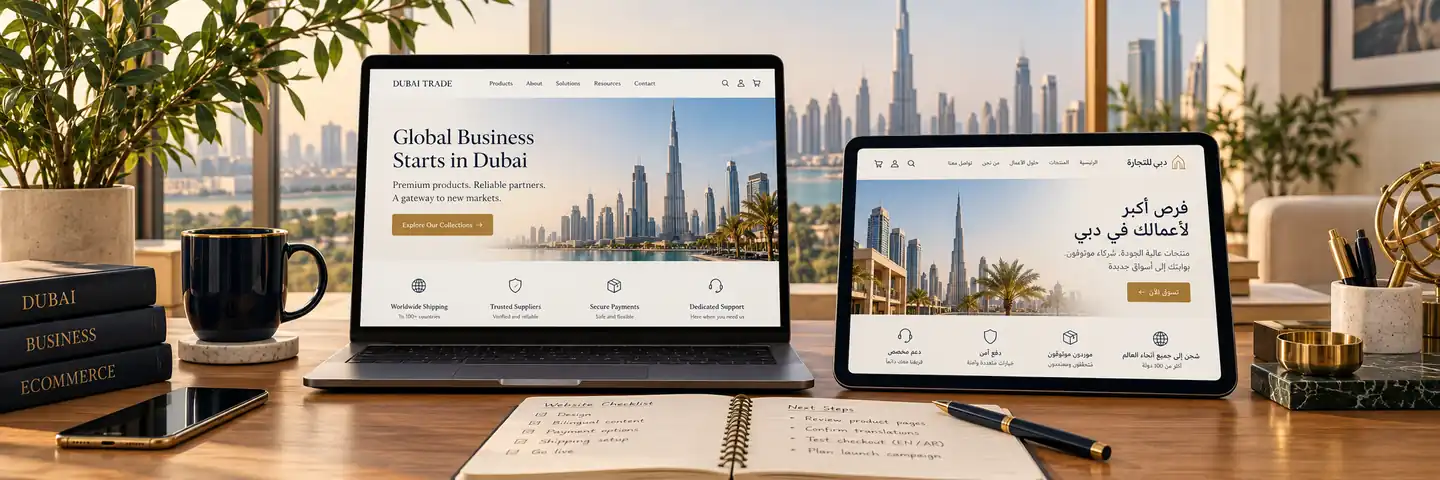
Choose the right WordPress or Shopify setup
WordPress websites
WordPress can support multilingual content through established plugins or carefully built custom workflows. The main questions are translation ownership, editorial permissions, SEO URL handling and compatibility with Elementor templates or custom fields.
If your site uses reusable custom content types, test how translated records map to parent and child pages. Do not install a multilingual plugin directly on a complex live site without staging and backups.
Shopify stores
Shopify supports international selling workflows, but available translation features, markets and theme capabilities depend on the store setup. Check which product fields, checkout areas, notifications and apps support the languages you need. Your team should review translated product variants, policies and payment messaging before launch.
For related development support, see Shopify development or web development in Dubai.
Translate the customer journey, not just the homepage
A bilingual ecommerce site is incomplete if Arabic users encounter English-only shipping terms at checkout or receive confusing confirmation emails. Map the entire journey: discovery, product research, cart, checkout, delivery, refund, account pages and customer support.
For service businesses, review lead forms, thank-you messages, appointment instructions and downloadable documents. Localized information must remain accurate when opening hours, prices or policies change.
Test both languages on real devices
Check common phone sizes, desktop navigation, long headings, mixed scripts and keyboard access. Ask native readers to review important pages for tone, clarity and mistakes. Test internal search, filters, language switching and validation errors in both languages.
Also test performance. Unoptimized media and duplicate translation scripts can slow pages significantly; avoid treating localization as a reason to abandon Core Web Vitals practices.
Maintain translation quality over time
A multilingual site needs an editorial process. Assign owners for translated pages, set a review schedule for key policies, and track which language versions need updating after product or service changes. A language selector that leads to outdated information is not a good user experience.
If a page cannot yet be translated well, decide transparently whether to delay that language version rather than releasing a misleading half-finished page.
Frequently asked questions
Does an Arabic website automatically rank higher in Dubai?
No. Arabic content can serve relevant searches, but visibility still depends on quality, competition, technical accessibility and other search signals.
Can I use automatic translation?
It can help create a first draft, but professional review is strongly recommended for high-impact content, brand voice and legal or product claims.
Do I need separate Arabic and English domains?
Not necessarily. Subdirectories can work well when implemented consistently; choose a structure you can maintain without creating duplicate or inaccessible URLs.
Related reading: How to choose a web developer in Dubai.