

Getting a Shopify store online is only the beginning. Search visibility comes from helping people find products, understand differences and trust what they are buying. If you run a store in Dubai or elsewhere in the UAE, Shopify SEO should connect technical basics with the questions local shoppers actually ask.
This guide prioritizes changes you can make without filling every product title with the word “Dubai.”
Start with a useful keyword map
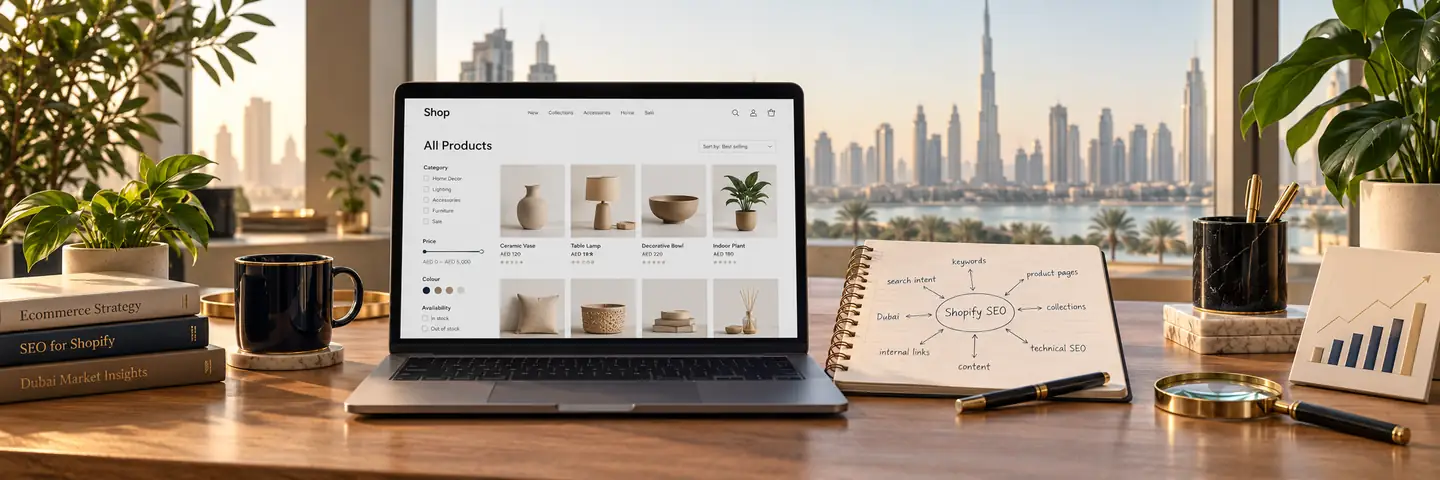
Group searches by their purpose. A broad category phrase belongs on a collection page, a product-specific phrase belongs on a product page, and a question such as “how do I choose…” often deserves a guide. Avoid making several near-identical pages compete for the same query.
For example, a skincare store might map a collection to “facial cleansers,” a product to its exact product name, and a blog guide to understanding different cleanser textures. Add location terms only where the offer genuinely has a local dimension, such as a Dubai delivery page.
Write down your priority collection URLs, supporting products and the questions your customers raise before you edit metadata.
Improve collections before publishing dozens of articles
Collections often act as the bridge between a search result and a purchase. Give each collection a clear headline, a brief introduction, relevant filters and products with understandable names. Make sure the collection can be found through navigation and links from related collections.
Shopify’s automatically generated collections can be efficient, but their names and product rules still need review. Avoid thin pages that consist of almost nothing beyond a grid of products with no context.
Write product pages for real decisions
A product description should explain what it is, who it may suit, the available variants, dimensions or ingredients where applicable, care information, and delivery or returns considerations. Use original imagery and precise specifications. Manufacturer copy pasted across dozens of stores rarely answers your customer’s specific doubts.
Descriptive image filenames and meaningful alt text help accessibility and image understanding. Alt text should describe the image rather than repeat a keyword. For example, “amber serum bottle beside its carton on a beige tabletop” is better than a list of Dubai-related phrases.
If you offer multiple variants, check whether each needs its own landing page or whether one product page is more helpful. Prevent thin duplicate URLs from becoming an indexing problem.
Optimize titles and snippets naturally
Give important pages a specific title and a human-readable meta description. Put the most useful distinguishing words early, without repeating the same phrase three times. Search engines may rewrite snippets, so the page itself must make the promise clear.
A practical collection title might be “Facial Cleansers | Zensual Cosmetics” rather than “Best Facial Cleansers Dubai UAE Facial Cleanser Shop.” The first reads like a real business; the second reads like a keyword list.
Review Shopify’s search engine optimization guidance and make sure your theme outputs the intended canonical URLs.
Make the site easier to crawl and use
Check that important products and collections are reachable through regular HTML links. Submit the store sitemap to Google Search Console, inspect key URLs and resolve accidental noindex, broken links and redirects. Do not expect a submitted sitemap to guarantee indexing.
Performance deserves attention too. Compress product imagery appropriately, avoid installing overlapping apps, keep mobile navigation responsive and minimize disruptive pop-ups. Use PageSpeed Insights and real-user Core Web Vitals reports where data exists, but prioritize improvements that also help shoppers.
For help with technical storefront changes, see Shopify speed optimization and Shopify development in Dubai.
Use blog content to support products
A helpful blog post should answer a genuine question and then link readers to the most relevant category or product. An article about choosing an online store platform can support your service pages, just as a buyer’s guide can support a product collection.
Build logical internal links: guide to collection, collection to product, and product to relevant policy or educational guide. Avoid inserting identical promotional anchors into every paragraph.
Track what improves, not just rankings
In Search Console, monitor impressions, clicks, queries, pages and device breakdowns. In your ecommerce analytics, track relevant actions such as add-to-cart and completed orders where accurately configured and permitted. A page attracting unrelated traffic may look successful on a ranking report but contribute little to the business.
Review a small group of priority pages monthly. Improve product information, add genuine answers, and check for technical regressions before commissioning large volumes of generic content.
Frequently asked questions
Is Shopify good for SEO in the UAE?
It can support a sound SEO foundation. Results depend on your content, products, competition, technical setup and site experience, not on the ecommerce platform alone.
Do I need “Dubai” in every product title?
No. Use location language where it accurately helps a shopper. Unnecessary repetition makes titles less useful and can dilute page intent.
How quickly will Shopify SEO show results?
There is no reliable fixed timeline. Search engines need to discover and evaluate pages, and competition and existing authority vary widely.
Related guide: How to market an ecommerce store in Dubai.