

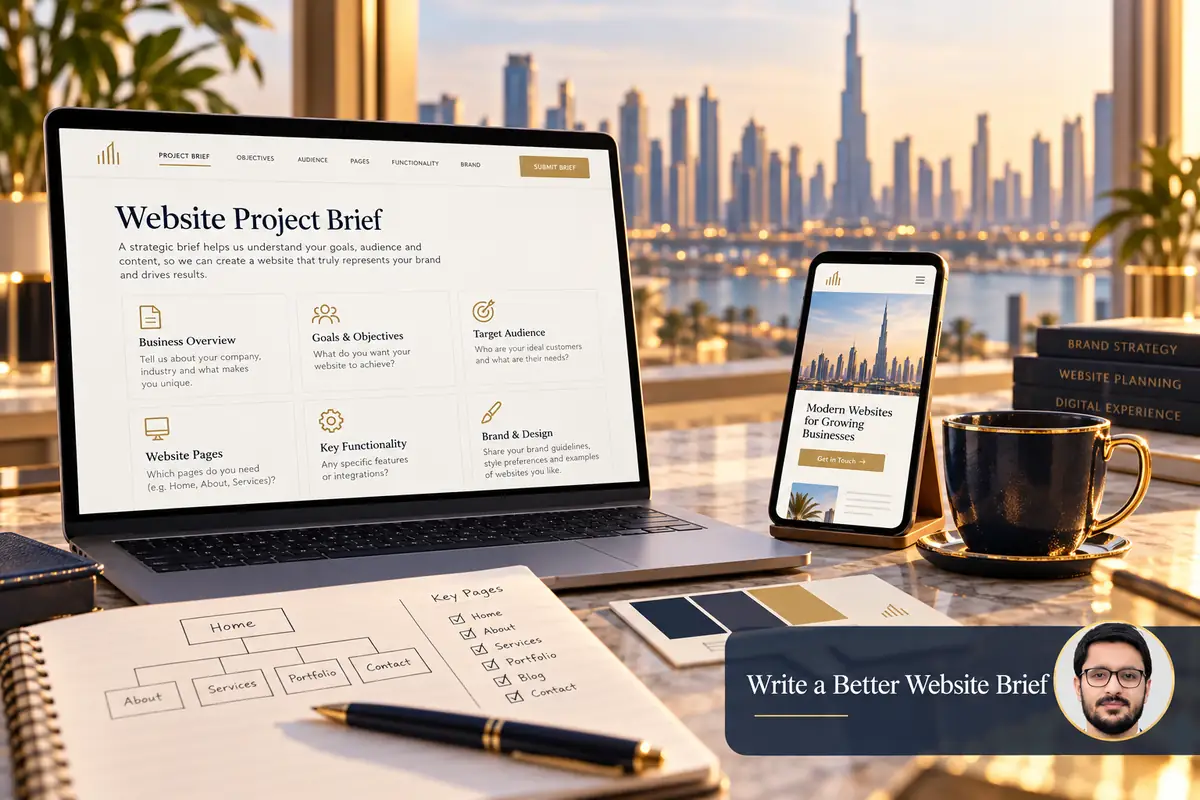
A website project brief helps a developer estimate the work you actually need. It does not have to be a long technical document. It needs to explain the business goal, the customer journey, the content and the responsibilities clearly enough that different proposals can be compared.
When a brief only says “a modern website like this example”, important assumptions remain hidden. One quote may include content entry and integrations while another covers only a visual layout. Use the following structure to make those differences visible.
1. Describe the business problem
Explain why the project is happening and who the website serves. Identify the main task: presenting services, collecting qualified enquiries, selling products or maintaining a property catalogue. Describe the current problem without prescribing a tool before the requirement is understood.
Choose a small number of useful success measures. For example, you may want a working enquiry handover or an easier product-editing process. Avoid asking for a guaranteed sales or ranking increase that a website build alone cannot control.
2. List pages and content ownership
Create a provisional sitemap and distinguish unique layouts from pages that can share a template. Note language versions, downloads, articles and other content types. Explain whether existing content will be retained, rewritten or created from scratch.
- Who writes and approves the text?
- Who supplies licensed images and brand files?
- How many products, projects or articles need initial entry?
- Who checks translations and industry-specific information?
- What material must be ready before design can progress?
Content quantities affect scope. A developer importing an organised product file faces a different task from manually cleaning hundreds of inconsistent records.
3. Describe features as user journeys
Instead of writing “CRM integration”, describe what should happen when a customer submits a form: which fields are collected, where the record goes and who receives it. For a store, explain product options, payment methods, delivery arrangements and order handling.
Separate essential functions from optional improvements. This gives the supplier room to propose a manageable first phase without silently dropping requirements that matter.

4. Explain design references precisely
Share examples and say what you like about each: navigation, spacing, product presentation or typography. Do not assume the reference’s photography, copy or proprietary design can be copied. Identify the assets you own and the brand rules to preserve.
Include mobile expectations. A desktop screenshot does not define how a menu, gallery or form should behave on a phone. State any accessibility or approval requirements that will affect design decisions.
5. Identify existing systems and migration work
List the current platform, domain, hosting, analytics and important integrations. Describe who controls access without including passwords in the brief. Note any URLs, customer records, products or historic orders that need a migration plan.
If search visibility matters, ask for a URL inventory, relevant redirects and launch checks. Our redesign SEO guide explains why those tasks should be scoped before the new site is ready.
6. State practical constraints
Give a realistic target launch window, the reason for it and any fixed dependencies. Explain who approves work and how feedback will be consolidated. A deadline cannot be assessed properly if content availability and decision-making are unknown.
Share a budget range if possible, together with the priorities it needs to cover. Ask suppliers to identify recurring costs, licences, hosting, support and items excluded from the build price.
7. Ask for comparable proposals
- Deliverables and page templates.
- Content entry and migration quantities.
- Integrations and their boundaries.
- Testing and acceptance criteria.
- Training, documentation and handover.
- Ongoing responsibilities and recurring costs.
Review assumptions as carefully as the total price. Where a requirement is uncertain, ask for a discovery step or a clearly described allowance rather than treating a guess as a fixed commitment.
A copy-and-complete website brief
Use the prompts below as a working outline. Describe requirements and ownership; share credentials only through an agreed secure access process.
- Objectives: We need the website to help customers ______. The current problem is ______.
- Audience: Our priority customers, locations and languages are ______.
- Pages and content: Required pages/content types and approximate quantities are ______. Text, images, translations and approvals are owned by ______.
- Features: The essential user journeys are ______. Optional phase-two features are ______.
- Integrations: Forms, CRM, payments, booking, email or inventory systems must exchange ______; failures should be handled by ______.
- Design: References are ______; the specific navigation, typography or layout features we like are ______.
- Budget: The working range is ______; proposals should separate one-off work from licences, hosting and ongoing costs.
- Timing: Target launch and dependencies are ______. The approver and feedback owner are ______.
- Acceptance and support: Sign-off requires ______. Training, maintenance and post-launch responsibility belong to ______.
Send the completed outline when discussing website development, WordPress development or a Shopify project. This is a scoping tool, not a promise of a fixed price without reviewing the requirements.
Frequently asked questions
Do I need to choose a platform first?
Not always. Explain the operational needs and existing constraints so a suitable platform can be assessed.
Can I brief a project before all content is written?
Yes, but identify the content types, approximate quantities and responsible people so the estimate has a clear basis.
Will a detailed brief eliminate every change?
No. It provides a shared baseline so new requests and assumptions can be discussed transparently.
Read how to choose a web developer and explore business website design. Share your project outline to discuss an appropriate scope.