

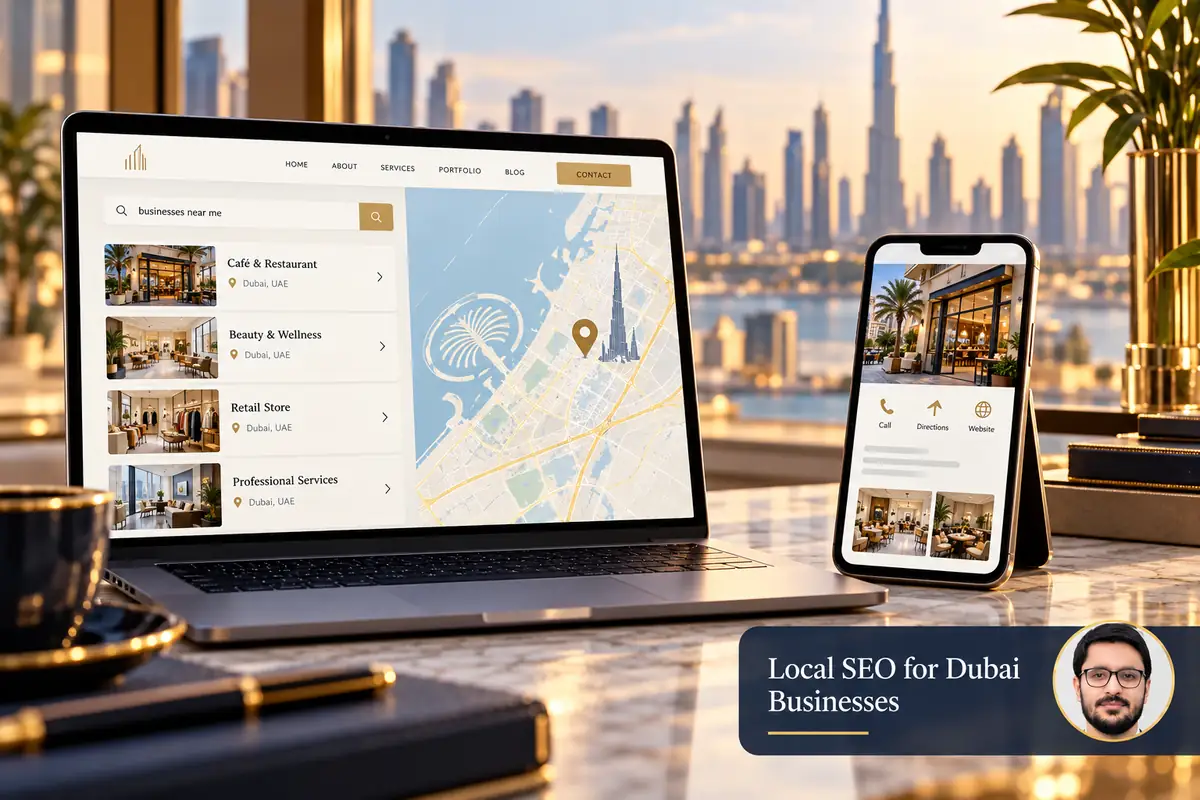
Local SEO helps a service business explain what it does, where it works and how customers can contact it. For a Dubai business, that starts with accurate information and useful service pages, not with adding a list of neighbourhood names to every paragraph.
This setup guide focuses on practical foundations. Local visibility depends on competition and relevance, and no provider can guarantee a particular map position.
1. Confirm Business Profile eligibility
Check Google’s Business Profile representation guidelines before creating or changing a listing. Use your real business identity and the address or service-area arrangement that accurately represents how you operate. Do not create a fictional office simply to target another area.
Keep control of the account within the business and assign access deliberately. Record who manages changes and who receives customer messages. If a profile already exists, resolve ownership rather than creating a duplicate.
2. Make the core business details consistent
Check the business name, telephone number, website, opening hours and service descriptions. Use accurate categories and describe actual services. Update special hours when needed and ensure contact links on the website lead to working destinations.
Consistency should reflect reality. If your business moves, changes its telephone number or stops offering a service, update the relevant records rather than preserving outdated information for the sake of matching old listings.
3. Build service pages that answer local questions
Give important services their own clear explanations: who they are for, what is included, what information is needed and how to request help. Add genuinely useful local context such as service coverage or appointment arrangements.
Avoid creating many nearly identical location pages with only the place name changed. A useful page should provide distinct information for the visitor. Use descriptive internal links so customers can move from a general service to the option they need.
4. Understand what local ranking can and cannot do
Google explains that local results consider relevance, distance and prominence. Its local-ranking guidance also says businesses cannot pay Google for a better local ranking. Accurate information helps explain the business, but does not remove distance or competitive factors.
Use this as a reason to improve genuine relevance rather than chase ranking shortcuts. A clear service page and accurate business information are more useful than unsupported claims about being the best provider in every district.
5. Gather and manage feedback honestly
Ask genuine customers for feedback through an appropriate process. Do not invent identities, rewrite complaints as praise or publish project outcomes that were never measured. Respond professionally and use recurring questions to improve the website.
Keep photos and project examples accurate. If an image is a conceptual illustration, do not present it as a completed client project. A smaller set of genuine examples gives visitors a clearer basis for assessing your work.
6. Measure useful actions
Review available search visibility, relevant landing pages and actual enquiries together. A rise in impressions is not the same as more qualified work. Track contact actions where appropriate and compare reports with your enquiry records.
- Check business details and website links.
- Review priority service pages and mobile usability.
- Test enquiry delivery and contact routes.
- Record the source of qualified enquiries where possible.
- Review changes over a meaningful period.
Local setup: service areas, citations and structured data
Use Google’s business representation guidelines to decide whether the business qualifies and how its address should appear. A service-area business that visits customers and does not receive them at its premises should hide its address. A purely online business should not assume it qualifies for a profile.
- Local intent: separate a person seeking a Dubai service provider from someone looking for a general tutorial. Write the service page around coverage, scope and a practical contact route.
- Citations: check real business listings that customers use. Correct outdated names, phone numbers and website URLs; avoid bulk listings or fictional locations.
- Structured information: describe the actual business and services consistently with visible content. Use the appropriate entity type; do not invent a public office address or ratings to complete a schema field.
- Review process: invite honest customer feedback without incentives, selective pressure or fabricated identities. Keep ownership of the profile and review responses with the business.
A legitimate service area, relevant page or valid schema does not guarantee Maps placement. Prioritise accurate information and useful local SEO work over additional near-identical location pages.
Frequently asked questions
Do I need a separate profile for every area served?
Do not assume so. Follow Google’s eligibility and representation rules and avoid duplicate or fictional locations.
Can a new website guarantee a top map result?
No. A better website can address content and usability problems, but local ranking depends on several factors.
Should I target Arabic searches too?
Consider your actual audience and capacity to maintain accurate Arabic content and support. Translation should serve customers, not only keywords.
See SEO services and business website development. Our bilingual website guide covers language planning. Discuss your local search priorities with your current website and service coverage.